
Harley Tuning: Stage 1, Stage 2 and Mapping
Stage 1 and Stage 2 are the usual entry-level steps in Harley tuning: air filter and exhaust, and with Stage 2 also a different camshaft, each with matching mapping. Drag Race Choppers in Leverkusen is the workshop of Luca Campagnolo, master motorcycle mechanic and a drag racer himself.
Stage 1 and Stage 2: what is behind them
Stage is an industry term, not a standard. Each supplier divides the steps slightly differently, so the parts list matters more than the number. The usual division is this:
- Stage 1
- Replace the air filter and exhaust, then adjust the ECU mapping.
- Stage 2
- As Stage 1, plus a different camshaft, then adjust the mapping.
What makes sense for your Harley depends on the model, year, parts already fitted and your goal. We mainly work on the Milwaukee-Eight and Twin Cam engine families.
Air filter, exhaust and camshaft
Air filter and exhaust
Both determine how easily the engine draws in air and expels exhaust gas. An air filter with less resistance and an exhaust with less back pressure let more air through. However, the maps in the ECU are matched to the standard condition. That is why the mapping is part of the job.
Camshaft
The camshaft determines when and how far the valves open. A different camshaft shifts the rev range in which the engine delivers its torque. Depending on the camshaft, valve springs and other parts in the valve train must be matched too. Fitting it is an intervention in the engine and more work than the air filter and exhaust.
Mapping and dyno
Every stage that changes the airflow needs a new ECU mapping. Without it the mixture does not match the airflow, the engine wastes power and is under more stress. As an official dealer of Don Performance we map with their equipment, and heavily customised motorcycles are additionally run on our partner's dyno. How this works in detail is described under Harley mapping.
Tuning for Street Glide, Fat Bob and Breakout
With tuning, the engine matters most, less the model name. Street Glide, Fat Bob and Breakout are available with Twin Cam or Milwaukee-Eight depending on the year, i.e. with the two engine families we focus on. The Street Glide is a touring model. The Fat Bob was a Dyna model until the switch to the Milwaukee-Eight and has since belonged to the Softail family, like the Breakout.
Which parts suit your machine for Stage 1 or Stage 2 therefore depends mainly on year and engine. Tell us both when you enquire, and we will discuss what makes sense for your model.
Experience from racing
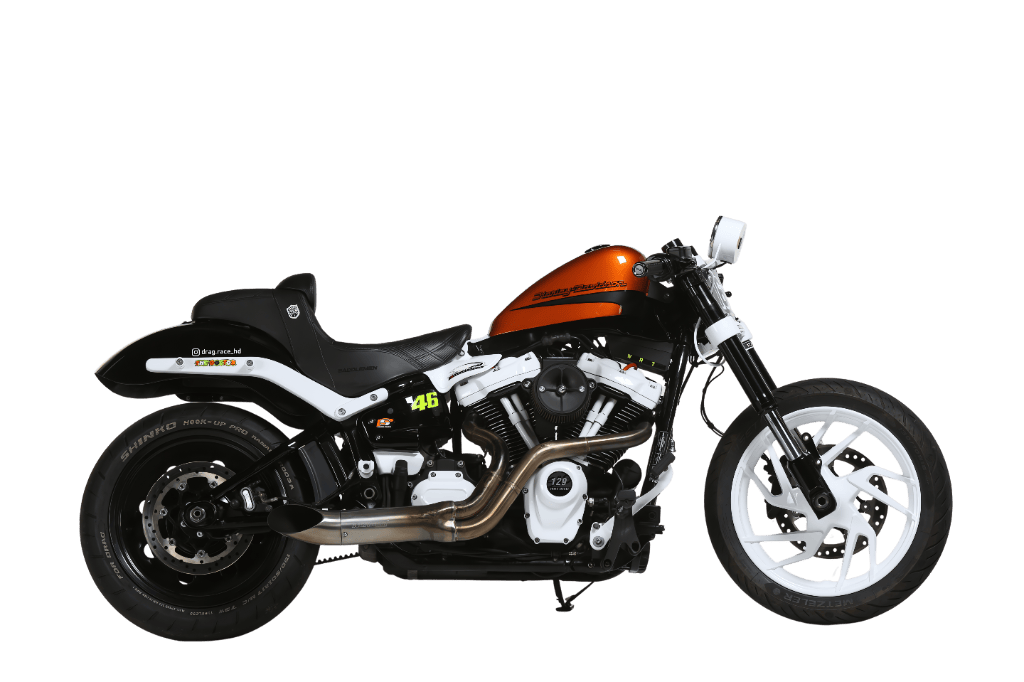
Luca rides drag races himself, including at Assen, Glemseck, Bottrop and Breda. The Drag Race Choppers race bike is a Sport Glide with a 129 ci performance kit, rated at about 170 PS according to the spec sheet.
Your Harley will not become a race bike, and it does not need to. The questions are the same, though: which parts go together, and how is the engine mapped to them?
When Stage 2 is not enough
Stage 1 and Stage 2 leave the displacement unchanged. If you want more, you need a bigger job: more displacement, different cylinders and heads, often called Stage 3 and Stage 4. That is an engine build and has its own page: Harley Big Bore Kit.
Enquire about tuning
Tell us the model and year, which parts are already fitted and what you want to achieve. We will get back to you and discuss which stage suits your Harley.
Frequently asked questions
Is Stage 1 or Stage 2 the right one for me?
That depends on what you want to do with the Harley and what is already fitted. Stage 1 is the smaller job and does not need a different camshaft. Stage 2 works on the valve train. Tell us the model, year, parts already fitted and your goal, and we will discuss it.
Can I start with Stage 1 and upgrade to Stage 2 later?
Stage 2 builds on Stage 1: the air filter and exhaust stay, and the camshaft is added. Because a different camshaft changes the airflow again, the mapping then needs adjusting. We will discuss whether and how that works on your model.
How does the mapping work?
We are an official dealer of Don Performance and work with their mapping device. It is used to adjust the ECU to the parts fitted, and then refined after test rides on the road. The details are under Harley mapping.
Do I need a dyno run?
You need a new mapping after every change that alters the airflow. For heavily customised motorcycles, for which no suitable maps are available, the dyno is part of the process: that is where we get the best out of the engine, and power and torque are measured. Measurements are carried out externally at our partner Don Performance. We will discuss during the enquiry whether a measurement makes sense for your build.
Is Harley tuning legal?
That depends on the parts. Some modifications are permitted on public roads, others are intended for racing only and must not be ridden on public roads. Tell us in your enquiry whether you ride the Harley on the road or only on the track. Then we will talk through which parts are an option for you. Road rules differ from country to country, so check what applies where your bike is registered.
How much does Stage 1 or Stage 2 cost?
It depends on the model and year, the condition of the Harley, the parts you choose and the amount of mapping work. Stage 2 adds the camshaft fitting, which is more work than the air filter and exhaust. We will give you a price once we know the model, year and what you have in mind.